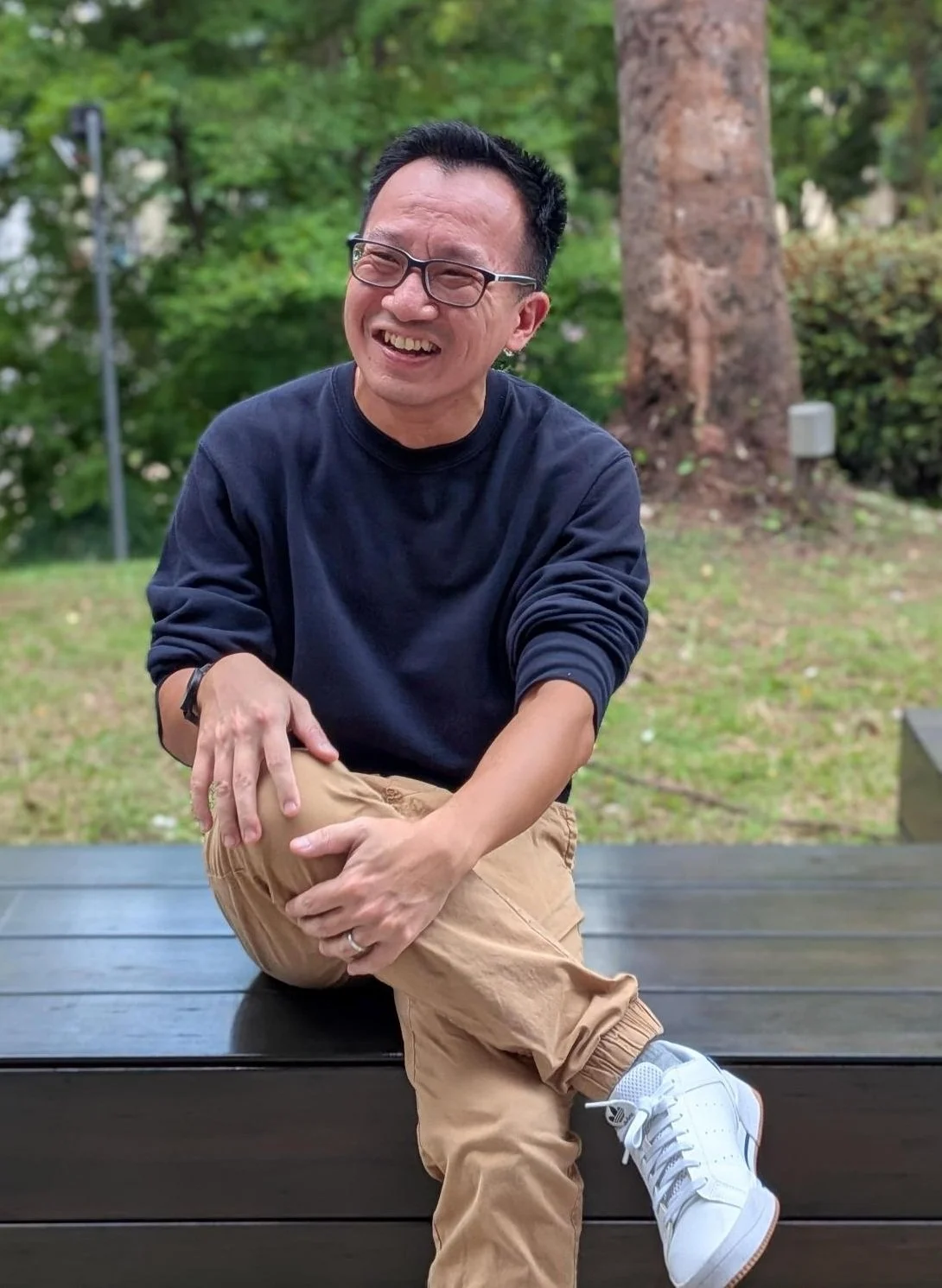
“Working as a Community Psychologist is simply working on our client’s turf.”
Kenny Cheong
Senior Clinical Psychologist
Psychological Services Division
The most meaningful moments in psychology for Kenny are not always the dramatic breakthroughs.
Sitting with someone through uncertainty. Understanding the world as they experience it. Working alongside others supporting them. Staying long enough to see them through to their goals.
It is this closeness to people, and to the realities of their everyday lives, that drew Kenny to psychology in the first place. Years into his career, it is what brought him to Community Psychology Hub (CPH).
His Pathway in Psychology
“My journey to where I am today, or rather my educational route, was what people would call unconventional.”
After graduating from the National University of Singapore in 2010, he spent some time in research before making what many would call an unusual decision: he returned to university at James Cook University to pursue a similar degree, this time with honours.
It was, in many ways, a second chance to pursue psychology more deeply after being unable to undertake a thesis during his first degree.
That persistence eventually took him to Australia for postgraduate training in Clinical psychology and geropsychology and, later, into a local public hospital, where he worked with adult psychiatric patients. His clients ranged from those struggling to engage with treatment to individuals experiencing significant psychological distress.
But another chapter of his career would take him beyond the walls of the hospital and deeper into the community.
Seeing People at Their Most Vulnerable
For the next five years at the Ministry of Social and Family Development (MSF), Kenny worked closely with cases involving vulnerable adults facing abuse, neglect or self-neglect under Singapore’s Vulnerable Adults Act. It was psychology at the point of crisis.
At times, he would encounter some of the most severe cases that remain vivid in his memory today, even working alongside paramedics and police officers.
The work mattered deeply and it also clarified the kind of psychologist Kenny wanted to become.
He wanted to journey with clients beyond the crisis.
From Crisis Intervention to “Working in Their Turf”
Today, Kenny serves as an MSF Secondee to CPH where he works with the Vulnerable Adults team under the Psychological Services Division.
There is rarely a typical day. Depending on his appointments, Kenny may be travelling across Singapore to meet a client, working remotely on case documentation, consulting for a SSA, attending training, or supervising a junior psychologist.
More importantly, he gets to meet clients where their lives unfold in the community.
“It’s simply working on their turf.”
Rather than perceiving someone within the confines of the office, being this close to the ground meant Kenny can understand the relationships, circumstances, and systems surrounding his clients. All of which are crucial to explore as Kenny collaboratively develops longer-term, meaningful goals together.
Privilege of Walking Alongside Someone
One individual remains close to Kenny’s heart.
A client had lived with chronic anxiety for much of his life, with very frequent admissions into the emergency department of a hospital whenever he faced a panic attack, to the point of being unable to take public transport. Yet over the course of 10-12 sessions, Kenny noticed meaningful changes in how the client understood and managed his anxiety, something particularly moving given how long he had lived with it. The client no longer needs to admit himself to the emergency department and can now travel independently in public.
There was little illusion that years of difficulty could simply disappear within a few sessions. As Kenny put it, this progress was likely built on years of perseverance by the client, alongside the support of allied health professionals who had walked with him over time.
Being able to witness this journey and transformation was the kind of deeply personal work Kenny had hoped to immerse himself.
“Seeing them change through those weeks in their life was something I found very heartening.”
Growing Alongside the People Around Him
“Training resources in CPH are generous and flexible (for work-related learning) as long as it is useful to you.”
Rather than following a one-size-fits-all development pathway, Kenny appreciates the flexibility CPH gives him to pursue training relevant to his work’s needs. This has allowed him to deepen his exposure to approaches such as Attachment – Focused Eye Movement Desensitisation and Reprocessing (AF-EMDR).
His role has also given him more opportunities to supervise junior psychologists and postgraduate interns, something he finds rewarding in a different way. For those earlier in their careers, that culture of supervision means learning does not happen only through formal courses, but through conversations, cases, and colleagues.
Beyond formal development, Kenny also appreciates CPH’s relatively flat and supportive culture. Help is rarely confined by divisional lines, with colleagues readily stepping in to support. Simpler traditions, such as CPH’s monthly “Nom Nom Fridays” lunches, also create space for colleagues to reconnect beyond the demands of their work.
For Kenny, community psychology ultimately means being willing to step beyond the consulting room, meet people where they are, and stay alongside them long enough for change to take root.
His advice to psychologists considering taking the same step?