“It’s a calling. Led by service and guided by grace.”
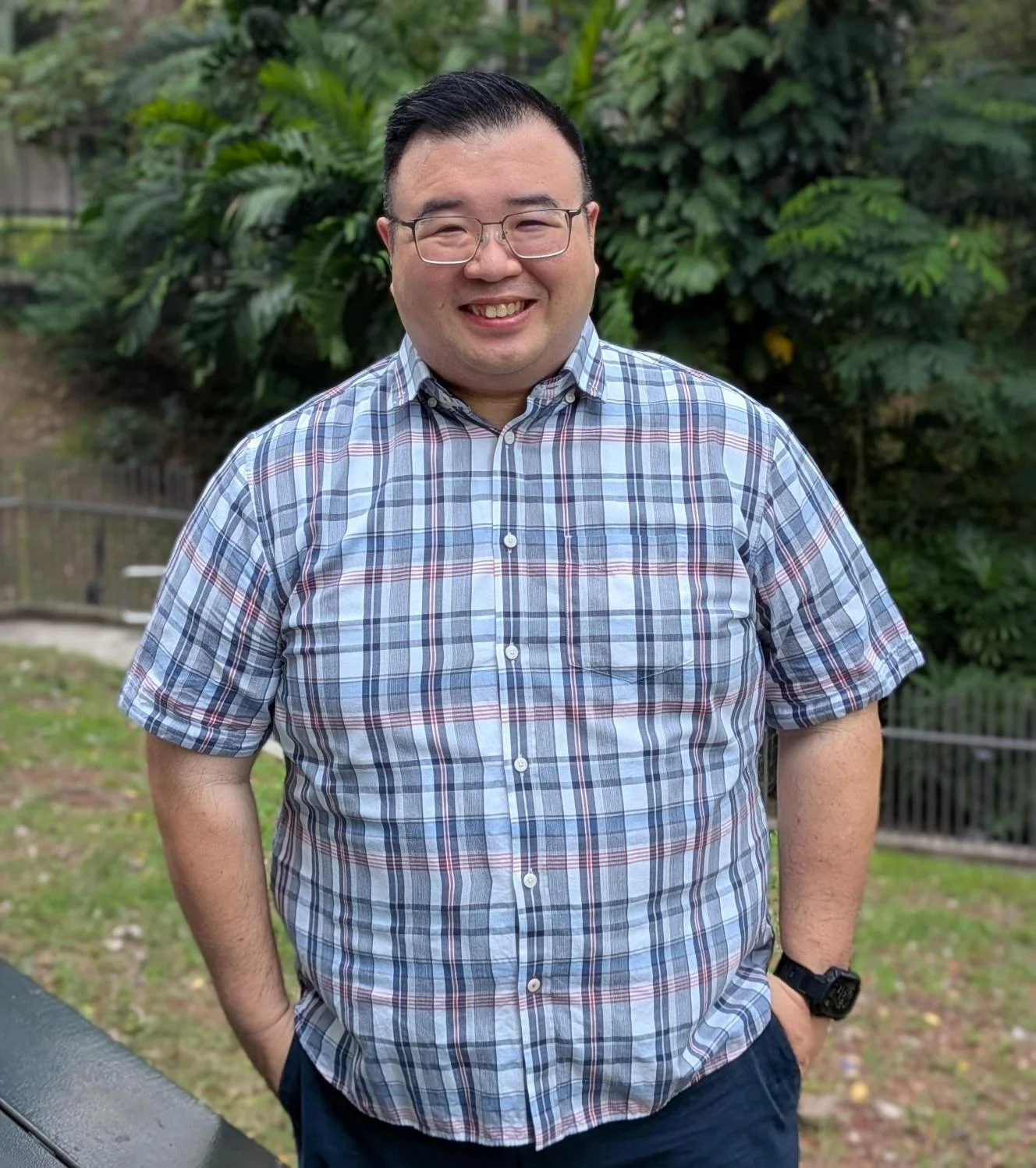
Mark Kuo
Forensic Psychologist
Adult Disability Services Division
Mark’s answer to a calling: A life of service
Some careers begin with a carefully mapped-out plan.
Mark’s began with a call to prayer.
Graduating with a degree in psychology, Mark found himself at a crossroad. He knew he wanted to work in the social service sector, but exactly where he belonged was less certain.
One Saturday, during Church service, Mark prayed for direction. In that quiet moment, he made a commitment to embrace whichever path he was called to, and to serve it with all his heart.
By Monday, the calls started coming. The first came from a Special Education (SPED) school. And he remained there for more than a decade.
Learning to see the person first
His first job became the very foundation of how Mark understands those he works with today.
Working closely with persons with disabilities (PWDs) taught him that support could never be one-size-fits-all. Behind every diagnosis and presentation of an individual, was a different way of communicating, learning, and experiencing the world. Mark then deepened his practice through a Diploma in Special Education and a Master of Special Education. Yet the longer he spent in the sector, the more he began noticing something else.
There were needs that education alone could not always address.
Some individuals required deeper psychological intervention, yet psychologists with experience adapting their practice for PWDs were far too uncommon. Supports that worked well for the neurotypical could not simply be transposed unchanged into the neurodiversity space.
This was not merely a gap in services for Mark.
He could contribute right here.
And so, years after completing his psychology degree, he found his way back to psychology as a Forensic Psychologist in Community Psychology Hub (CPH). With a master’s in forensic psychology, Mark carried more than a decade of experience from the ground with him.
Standing between different worlds
A career talk introduced Mark to CPH. Hearing about the work in Adult Disability and within the community, he recognised something familiar: psychology being brought into the environments where people lived, learned, and received support.
Mark currently leads a community psychology team dedicated to intervention programs and support services for PWDs.
To Mark, leadership means serving, actively walking alongside the community he supports.
He sees himself as a bridge.
On one side are persons with disabilities, each with unique individual needs. On another are social service agencies, operating within their own organisational realities and service models. Then there are the psychologists he leads, each bringing diverse strengths and personal working styles to the team.
It is a continuous practice of active listening, adapting, and building alignment.
Mark calls this adaptive alignment, the belief that meaningful solutions are born when individuals strive to understand differing perspectives before deciding on a unified journey.
That philosophy extends to how he develops his team of psychologists.
Conversations about growth are kept open and personal. Life pathways are more like journeys than identical ladders, and that could look different for everyone.
When warmth is part of work
Mark speaks candidly about the defining characteristic of CPH: warmth. As he puts it, “To me, CPH feels like a family of warm and caring people, who happen also to be dedicated professionals.”
He views CPH as a psychologically safe environment where seeking help means someone will always answer. This culture, he notes, was built intentionally through a leadership that prioritises open communication and a team that repeatedly chooses to show up for one another.
He finds himself carrying that same warmth into the social service agency he supports and notes that it shapes conversations, relationships, and how people navigate challenging situations together.
A personal trial of advocacy
A client, Qoo (not her real name), presented with significant executive functioning difficulties that affected her ability to initiate tasks, sustain attention, process instructions and manage impulsivity. Yet, year after year, Mark witnessed her growth. Qoo was eventually nominated as a school prefect, progressed through vocational training, graduated, and secured employment with a restaurant chain.
Mark still remembers unexpectedly meeting her there one day.
“Mr Mark, so happy to see you! Next time call me okay, I got staff discount!” Qoo proudly chirped.
It was a simple moment but knowing how far Qoo had come filled Mark with a sense of joy and peace that was difficult to describe. Beyond the achievements was something more meaningful; Qoo had found a place where she could contribute and belong.
Sometime later, Mark returned to the same restaurant, hoping to see Qoo again. Instead, he learnt that Qoo had sadly passed from natural causes.
The contrast was profound.
In this work, highest moments of celebration can sometimes sit beside profound loss. When you have walked alongside someone through their struggles, witnessed their growth, and invested in their journey, their absence is felt in an inexplicable way.
Qoo’s story gave Mark something beyond grief. Advocacy’s true meaning was one of them, alongside seeing the person beyond their challenges, believing in their potential, and being fully present in the journey.
Her memory continues to ground and shape Mark’s practice with greater empathy, humility, and purpose. To celebrate the small victories and to help each person move towards a life of greater dignity and possibility.
Service without a job title
Mark’s commitment to people also continues after the working week ends.
On weekends, he volunteers, counselling justice-involved persons at incarceration settings. He works with them to reconsider choices, motivations and what a life away from offending could look like.
Even how he connects with the people he supports, matters to him.
Not simply inmates or convicts, but justice-involved persons.
The person, first.
While circumstances may describe a small part of someone's story, they rarely define the person. Perhaps that is also why remuneration has never been Mark's primary measure of success. What gives the work value is something harder to quantify: being able to influence positive change in the people he serves, the professionals he develops, and the systems he helps connect.
More than a decade after answering his calling, Mark speaks about community psychology with the very same devotion that drew him to it.